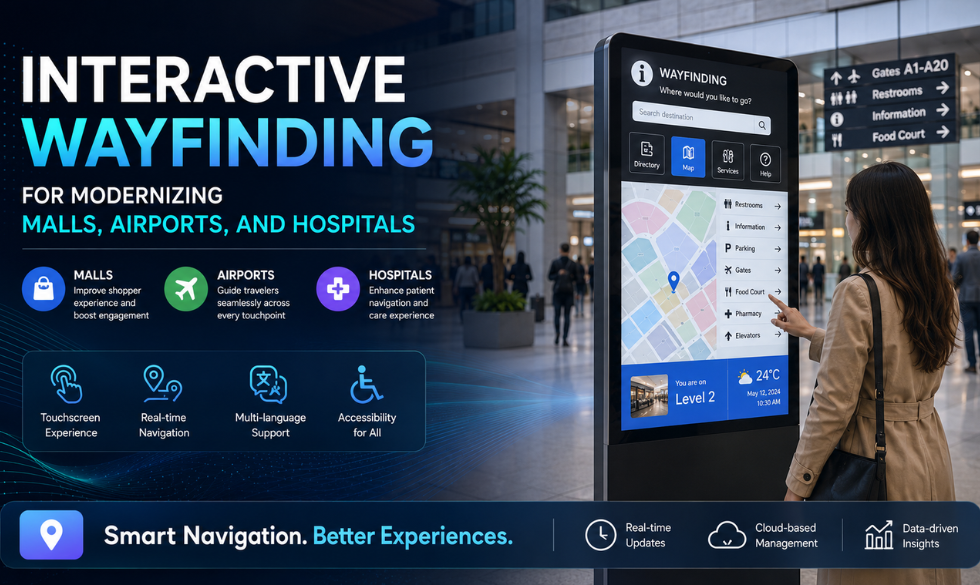
Every large facility has the same problem: people spend time being lost instead of shopping, boarding, or getting treated. That lost time hurts the visitor experience and, in commercial spaces, it hurts revenue too. Interactive wayfinding kiosks are becoming the standard answer, and adoption is accelerating fast across malls, airports, and hospitals.
A wayfinding kiosk is one specific application of the broader interactive kiosk category, built specifically around navigation rather than ordering, ticketing, or payments.
These numbers, reported by Business Research Insights, reflect a simple shift: static directories and printed maps are being replaced by digital, touch-driven navigation across the built environment.
What Is Interactive Wayfinding?
Interactive wayfinding is a digital navigation system, usually delivered through a touchscreen kiosk or a large interactive display, that helps people find a specific location inside a building or campus. Instead of scanning a printed directory, a visitor searches for a store, gate, or department, and the screen shows a highlighted route on a live map.
Most modern systems combine three things: an interactive map, a search or directory function, and a way to generate turn-by-turn directions, sometimes with a QR code that sends the same route to the visitor's phone so they are not tied to the kiosk.
Why Malls, Airports, and Hospitals Need It
Malls
A large mall can have hundreds of stores across multiple floors, and layouts change constantly as tenants move in and out. A printed directory goes out of date the moment a store relocates, while a digital wayfinding kiosk can be updated centrally in minutes. It can also promote current offers along the way, turning a simple direction lookup into a chance to highlight a sale the visitor might otherwise miss, an extension of how digital signage is already transforming the shopping mall experience.
Airports
Airports are high-stress, time-sensitive environments where a missed gate has real consequences. Interactive wayfinding at terminals helps passengers locate gates, lounges, baggage claim, and amenities quickly, and can factor in real-time flight information so directions stay accurate even when a gate changes at the last minute.
Hospitals
Hospitals are some of the most difficult buildings to navigate, with multiple wings, floors, and departments that all look alike to a first-time visitor. For patients and families who are often already stressed, getting lost adds unnecessary anxiety. A wayfinding kiosk at the entrance or on each floor can direct visitors to the right department, reducing the load on reception staff who would otherwise be giving directions all day. This fits into the wider role digital signage plays across healthcare facilities, from wayfinding to queue and patient information.
Key Benefits of Interactive Wayfinding
Faster, Accurate Routes
Visitors get a live, searchable map instead of a static directory that may already be outdated.
Fewer Direction Requests
Front desk and information staff spend less time repeating directions and more time on higher-value tasks.
On-Screen Promotions
Malls and retail spaces can surface offers and store highlights along a visitor's route.
Easier for Everyone
Large text, multiple languages, and QR handoff to mobile make wayfinding usable for a wider range of visitors.
Visitor Insights
Search terms and popular routes reveal what people are actually looking for in the space.
A Modern First Impression
A clean, responsive kiosk signals a well-run, technology-forward facility from the moment someone walks in.
Best Practices for Deploying Wayfinding Kiosks
Place Kiosks at Real Decision Points
Put screens at entrances, lift lobbies, and major junctions, the exact points where people pause and decide which way to go.
Keep the Map Data Current
Assign someone to update store changes, gate reassignments, or department moves as soon as they happen, since an outdated map is worse than no map at all.
Design for a First-Time User
Large touch targets, simple search, and minimal steps to a route matter more than a feature-heavy interface that takes time to learn.
Offer a Mobile Handoff
A QR code that sends the same directions to a visitor's phone means they are not stuck standing at the kiosk to remember the route.
Monitor Uptime Remotely
A wayfinding kiosk that is offline is actively unhelpful, since visitors expect it to work. Remote monitoring catches outages before visitors do.
Deploy Wayfinding on Intelisa's Platform
Intelisa's cloud-based platform runs interactive touch content on any kiosk and keeps it updated, monitored, and online from one dashboard, so your wayfinding map is never out of date.
- Runs interactive maps and touch content on any screen
- Update store, gate, or department data centrally in seconds
- Monitor kiosk uptime and troubleshoot without a site visit
- Scales from a single lobby kiosk to a full campus network
Frequently Asked Questions
What is interactive wayfinding?
Interactive wayfinding is a digital navigation system, usually a touchscreen kiosk, that helps visitors find a location inside a large building by searching for it and getting a highlighted route on a live map, instead of relying on a static printed directory.
Where is interactive wayfinding most useful?
It is most useful in large, complex facilities such as shopping malls, airports, hospitals, university campuses, and corporate offices, where visitors regularly struggle to find a specific store, gate, department, or room on their own.
How is a wayfinding kiosk different from a directory board?
A directory board is static and needs to be physically reprinted every time something changes. A wayfinding kiosk is digital, so store, gate, or department changes can be updated centrally within minutes, and the kiosk can also generate a personalized route rather than just listing locations.
Can wayfinding kiosks send directions to a visitor's phone?
Yes. Many wayfinding systems generate a QR code once a route is set, which a visitor can scan to continue following the directions on their own phone instead of needing to remember the route from the kiosk screen.
Does interactive wayfinding help with staff workload?
Yes. A large share of front desk and information staff time in malls, airports, and hospitals goes toward giving directions. A self-service wayfinding kiosk handles routine navigation questions, freeing staff to focus on tasks that need a human.
Is interactive wayfinding growing in adoption?
Yes. The global interactive wayfinding solutions market was estimated at approximately $3.42 billion in 2026 and is projected to reach $13.08 billion by 2035, growing at a 16.1% CAGR, with more than 70% of large malls having already adopted interactive wayfinding kiosks by 2024.
Final Takeaway
People do not remember getting where they needed to go quickly. They remember getting lost. Interactive wayfinding removes that friction from malls, airports, and hospitals, and as adoption grows across these spaces, a kiosk that cannot be updated or monitored centrally quickly becomes a liability rather than a convenience.
Ready to Modernize Your Wayfinding?
Intelisa's cloud platform lets you run, update, and monitor interactive wayfinding kiosks across your entire facility from a single dashboard.
Book a Free Trial