Categories
Digital Signages

The Art of Visual Storytelling: Captivating Audiences with Video Walls in Events and Exhibitions

Capturing the attention of an audience continues to become more challenging. In events and exhibitions, the use of video walls has emerged as a powerful tool to engage and captivate viewers. The art of visual storytelling takes center stage as these impressive displays seamlessly merge Display Technology and creativity to create a truly immersive experience.

Drawing inspiration from the world of cinema, video walls have the ability to transport audiences into a different realm, where brand stories are brought to life in vivid detail. These large-scale, high-resolution screens seamlessly blend together multiple videos, images, and animations, captivating viewers with their larger-than-life presence.

With their ability to attract attention and spark curiosity, Digital Billboard-style video walls have become a must-have for brands looking to make a memorable impact at events and exhibitions. It’s time to embrace the art of visual storytelling and harness the power of video walls to captivate, engage, and leave a lasting impression on your audience.

What are video walls?

Video walls are large-scale displays that consist of multiple screens seamlessly connected to form a single, cohesive display. These screens can be arranged in various configurations, such as a grid or a mosaic, to create a visually stunning effect. The screens can be LED panels, LCD panels, or projection-based, depending on the desired outcome and budget.

video walls

Common Video Wall Configurations

Video walls can be configured in various arrangements to suit different spatial constraints and visual preferences. Some common configurations include:

2×2 Grid

In a 2×2 configuration, four display panels are arranged in a square grid, typically with two panels across and two panels down. This setup provides a compact yet impactful display solution.

2×3 Grid

A 2×3 configuration consists of six display panels arranged in a rectangular grid, with two panels across and three panels down. This arrangement offers a wider aspect ratio compared to a 2×2 grid, which is ideal for showcasing widescreen content or creating immersive environments.

In some installations, the individual display panels may be angularly oriented rather than aligned perfectly parallel to each other. This angular orientation can create visually dynamic displays that stand out and draw attention.

For artistic or avant-garde installations, video wall panels may be arranged in a non-linear or seemingly random pattern. This unconventional arrangement can be used to create unique visual effects and artistic expressions.

Benefits of using video walls in events and exhibitions

Let’s now look at some benefits of installing video walls in events and exhibitions:

Attention-Grabbing

Video walls instantly attract attention and create a sense of awe, making a lasting impression in crowded event spaces.

Flexibility in Content Display

Brands can blend videos, images, and animations seamlessly on video walls, allowing for dynamic storytelling and engaging experiences tailored to the target audience.

Scalability

Video walls can be customized in size and configuration to fit any event space, from small booths to large exhibition areas, ensuring effective communication with various audience sizes.

Types of video walls and their features

Video walls come in various types, each with its own unique features and benefits. The most common types include LED video walls, LCD video walls, and projection-based video walls.

LED Video Walls

LED video walls are known for their high brightness and excellent color reproduction. They are suitable for outdoor events and locations with high ambient light. LED panels are modular, allowing for easy customization of size and shape. They also offer a wide viewing angle, ensuring that the content is visible from different perspectives.

LCD Video Walls

LCD video walls, on the other hand, are great for indoor events and exhibitions. They offer excellent image quality, with a high resolution and contrast ratio. LCD panels are thin and lightweight, making them easy to install and transport. They also consume less power compared to LED video walls, resulting in lower operating costs.

Projection-Based Video Walls

Projection-based video walls use projectors to display content on a large surface. They offer flexibility in terms of screen size and shape. Projection-based video walls are ideal for temporary installations or events where portability is important. However, they may require additional setup and calibration to achieve optimal image quality.

Planning and designing your video wall display

Before diving into the content creation process, it is important to plan and design your video wall display. Consider the following factors while doing the same:

Space and Configuration

Begin by assessing the event space and audience demographics to determine the optimal size and layout of the video wall. Experiment with different configurations to maximize visual impact, considering factors like available space and viewing distance.

Content Flow and Organization

Plan the narrative and content organization carefully. Decide whether the content will follow a linear sequence or incorporate a variety of media formats. Ensure a smooth and engaging visual experience for the audience by structuring the content effectively.

Technical Considerations

Pay attention to technical aspects such as resolution, aspect ratio, and content format. Optimize the content for the specific video wall configuration to achieve the best image quality. Seek guidance from professionals or experts to ensure seamless setup and operation of the video wall.

Content creation tips for video walls

Creating content for video walls requires a different approach compared to traditional displays. Here are some tips to help you create compelling and engaging content for your video wall display:

Keep It Visually Engaging

Video walls offer a canvas for creativity, so make sure to take advantage of it. Use high-quality images, captivating videos, and attention-grabbing animations to create visually stunning content.

Tell a Story

Instead of simply showcasing products or services, focus on telling a story that resonates with your audience. Craft a narrative that captivates viewers and leaves a lasting impression.

Consider the Context

Think about the event or exhibition theme and the target audience. Tailor your content to align with the context, ensuring that it is relevant, relatable, and impactful.

Optimize for Attention

Video walls have the power to attract attention, but it’s important to keep the content engaging to maintain viewers’ interest. Consider the pace, duration, and sequencing of your content to create a captivating experience.

Test and Iterate

Don’t be afraid to experiment with different content variations. Test your content on the video wall before the event or exhibition to ensure optimal visual impact. Gather feedback and iterate based on audience reactions.

Remember, the goal is to create a memorable and immersive experience that captivates your audience. Utilize the power of visual storytelling to create a lasting impression.

Examples of successful video wall installations

To inspire your own video wall creations, let’s explore some examples of successful video wall installations:

Nike: “Unlimited Stadium”

Nike created a massive circular video wall installation in the shape of a running track. Visitors were able to compete against a virtual avatar of themselves, creating a highly interactive and engaging experience.

Video Wall

BMW: “Art Cars”

BMW used video walls to showcase their iconic Art Cars, which are custom-designed vehicles created by renowned artists. The video walls displayed high-resolution images and videos of the Art Cars, allowing viewers to appreciate the intricate details and artistic expressions.

video wall installations

These examples demonstrate the power of video walls in creating immersive and memorable experiences. By combining creativity, technology, and storytelling, brands can captivate their audience and leave a lasting impression.

Measuring the success of video wall campaigns

Measuring the success of your video wall campaigns is essential to understand the impact and ROI of your efforts. Here are some key metrics to consider:

Engagement Metrics

Track metrics such as dwell time, interaction rate, and audience participation to gauge the level of engagement with your video wall display. This will help you understand how effectively you’re capturing and holding viewers’ attention.

Social Media Metrics

Monitor social media mentions, shares, and engagement related to your video wall campaign. This will provide insights into the reach and impact of your campaign beyond the physical event or exhibition.

Lead Generation and Conversions

If your video wall display is part of a larger marketing campaign, track lead generation and conversions to measure the effectiveness of your efforts. This can include tracking QR code scans, website visits, or inquiries generated through your video wall display.

Post-Event Surveys and Feedback

Gather feedback from event attendees to understand their perception and experience of your video wall display. Conduct post-event surveys or interviews to gather qualitative insights that can help inform future campaigns.

By analyzing these metrics, you can gain valuable insights into the success of your video wall campaigns and make data-driven decisions for future events and exhibitions.

customized video walls

Install customized video walls with Intelisa!

As technology continues to advance, the art of visual storytelling in events and exhibitions will only become more important. Video walls offer a unique and powerful medium to captivate and engage audiences, creating immersive experiences that leave a lasting impression.

But with so many areas to keep in mind, you need a team of experts who can help you implement these video walls with ease. Intelisa provides you with customized digital solutions to give you the flexibility to arrange video walls as per your preference.

Be it a 2×2 screen arrangement, 2×3 screen arrangement, angularly oriented, or random screen arrangement, our hardware is deeply integrated with our software, which helps us offer you tight customizable control over screens.

Want to learn more about how Intelisa can help?

Book a free trial today!

Categories
Digital Signages

From Static to Dynamic: How Digital Billboards are Transforming Marketing

As we enter 2024, one thing is clear- traditional marketing tactics are quickly becoming obsolete.

Digital billboards are changing the marketing landscape with their eye-catching visuals, interactive capabilities, and methods of engaging with the target audience.

Gone are the days of static, one-dimensional billboards. Digital billboards offer dynamic content that can be updated in real-time, ensuring advertisers can deliver timely and relevant messages to their audience.

With this flexibility, brands respond quickly to changing market trends, launch new products, or showcase limited-time offers.

But it’s not just about the graphics. Digital billboards provide a platform for interactive experiences, allowing consumers to engage directly with the brand.

From QR codes that lead to exclusive offers to live polls and social media integrations, digital billboards create a seamless connection between offline and online marketing efforts.

But that’s not all; today, we will dive into more of how digital billboards are transforming the marketing landscape.

The evolution of billboards in marketing

Billboards have long been a staple of outdoor advertising, capturing the attention of passersby and spreading brand messages, be it India, Canada, the USA, or the Middle East. However, traditional billboards have limitations.

They are static, one-dimensional displays that can only showcase a single message for an extended period. In a dynamic and ever-changing market, this approach doesn’t cut it anymore.

What are digital billboards?

Digital billboards, on the other hand, offer a whole new level of flexibility and creativity. These innovative displays combine high-resolution screens, advanced technology, and real-time content updates to create captivating advertising experiences. Unlike their static counterparts, digital billboards allow for dynamic and interactive content that can be changed on the fly.

digital billboards

Digital billboards come in various sizes and formats, from small roadside displays to larger-than-life screens in bustling city centers. They are strategically placed in high-traffic areas, ensuring maximum visibility and reach. With their vibrant colors, sharp images, and motion capabilities, digital billboards effortlessly grab attention and make a lasting impression on viewers.

Advantages of digital billboards over static billboards

Here are some advantages of choosing digital billboards over static billboards:

Real-Time Content Update

Firstly, digital billboards offer unparalleled flexibility. Advertisers can update their content in real-time, allowing them to stay relevant and adapt to changing market conditions. Whether it’s announcing a flash sale, promoting a new product, or showcasing user-generated content, digital billboards provide the agility needed to keep up with the fast-paced world of marketing.

Targeted Advertising

Secondly, digital billboards enable targeted advertising. With the ability to schedule different messages at specific times of the day, advertisers can tailor their content to different audiences. For example, a breakfast cereal brand can display a morning-themed advertisement during rush hour, while a luxury car brand can showcase its latest model during evening commute hours. This level of customization ensures that brands are reaching the right people at the right time.

Delivers Interactive Experiences

Digital billboards also provide interactive experiences by incorporating elements such as QR codes, augmented reality, or touch screens to motivate customers to take action. For example, a fashion retailer can display a QR code that leads to an exclusive online discount, encouraging passersby to scan and shop instantly. This seamless connection between offline and online marketing efforts helps bridge the gap between the physical and digital worlds.

Case studies of successful digital billboard campaigns

Share a Coke Campaign by Coca-Cola

To truly understand the power of digital billboards, let’s take a look at some real-life examples of successful campaigns. One such example is the “Share a Coke” campaign by Coca-Cola. The company utilized digital billboards to display personalized messages, allowing consumers to see their names or personalized messages on the screen. This campaign not only generated buzz and social media engagement but also increased sales and brand loyalty.

McDonald’s Promoting Limited Period Offers

Another noteworthy campaign is that of McDonald’s, which leveraged digital billboards to promote their limited-time offers. By showcasing mouth-watering images of their latest menu items and updating the content regularly, McDonald’s was able to drive foot traffic to their stores and create a sense of urgency among consumers.

Tips for creating effective digital billboard content

Creating effective digital billboard content requires careful planning and consideration. Here are some tips to help you make the most out of this advertising medium:

1. Keep It Simple

Digital billboards are meant to grab attention quickly, so avoid cluttering the screen with excessive text or visuals. Stick to a concise and compelling message that can be understood at a glance.

2. Use High-Quality Visuals

Invest in high-resolution images and videos that can captivate viewers. The quality of your visuals can make or break the impact of your digital billboard.

3. Incorporate Motion

Take advantage of the dynamic nature of digital billboards by adding motion to your content. Animation, video clips, or even subtle movements can make your message more engaging and memorable.

4. Optimize for Readability

Ensure that your text is easy to read from a distance. Use large fonts, clear typography, and contrasting colors to maximize legibility.

5. Call to Action

Prompt viewers to take action by including a clear call to action in your digital billboard. Whether it’s visiting a website, scanning a QR code, or following your brand on social media, make it easy for consumers to engage with your brand.

The role of technology in digital billboard advertising

Technology plays a crucial role in the success of digital billboard advertising. Advanced software and hardware systems enable real-time content updates, remote monitoring, and data analytics. With these tools, advertisers can track the performance of their campaigns, measure audience engagement, and make data-driven decisions to optimize their content.

digital billboards

Additionally, technologies like GPS and geofencing allow for location-based targeting, ensuring that advertisements are displayed to the right audience in the right place. This level of precision targeting helps maximize the impact of digital billboard advertising and increase return on investment.

How Digital Billboards are Changing the Marketing Landscape

Digital billboards are not just a passing trend; they are changing the entire marketing landscape. By offering a dynamic and interactive platform, digital billboards are blurring the lines between offline and online advertising. They provide a bridge that connects physical spaces with digital experiences, allowing brands to create cohesive and immersive marketing campaigns.

Furthermore, digital billboards enable real-time marketing, allowing brands to respond quickly to trends, events, or market changes. With the ability to update content instantly, advertisers can deliver timely and relevant messages to their audience, enhancing brand relevance and consumer engagement.

Challenges and limitations of digital billboard advertising

While digital billboards offer numerous benefits, they also come with their fair share of challenges and limitations:

Cost

One of the main challenges is the cost associated with implementing and maintaining digital billboards. The initial investment, as well as ongoing maintenance and content creation costs, can be significant. Therefore, it’s essential for brands to consider their budget carefully and the expected return on investment before diving into digital billboard advertising.

Information Overload

Another limitation is the potential for information overload. With multiple digital billboards in a single location, consumers may be bombarded with too many visual stimuli, leading to message fatigue or even ignoring the advertisements altogether. Advertisers must strike a balance between grabbing attention and overwhelming viewers.

Cost considerations for implementing digital billboards

Implementing digital billboards requires careful financial planning. The cost of digital billboards can vary depending on factors such as size, location, and technology features. Additionally, ongoing expenses such as content creation, software updates, and maintenance should be factored into the budget.

However, it’s important to note that despite the initial costs, digital billboards can offer a high return on investment. Their ability to attract attention, engage viewers, and provide data-driven insights can lead to increased brand awareness, foot traffic, and sales.

Conclusion: The future of digital billboard advertising

Digital billboards have transformed the marketing landscape, revolutionizing the way brands engage with their audience. With their dynamic content, interactive experiences, and real-time updates, digital billboards offer a new level of flexibility and creativity in advertising.

As technology continues to advance, we can expect digital billboards to become even more sophisticated. From personalized messaging based on audience demographics to enhanced targeting capabilities, the future of digital billboard advertising is promising.

To stay ahead of the curve and make the most out of this powerful advertising medium, brands should embrace digital billboards as an integral part of their marketing strategy.

Furthermore, dynamic billboards and digital signage are equally gaining traction, and businesses in India, the USA, Canada, and the Middle East continue to use them to their advantage.

Still not sure how to include this in your advertising strategy? Contact our team today, and we’ll help you out!

Categories
Digital Signages

Digital OOH Advertising Guide: Benefits and Strategies

Digital OOH, or digital out-of-home advertising, is a dynamic and high-impact form of advertising that uses digital screens, often placed in public spaces such as malls, airports, and transit stations, to deliver marketing messages to a wide audience.

Unlike traditional static billboards, digital OOH allows the display of a variety of content, including images, videos, animations, and even real-time information, making it a versatile and attention-grabbing medium for companies across many countries, including India, Canada, the US, and the Middle East.

In this guide we will explain what digital OOH advertising is, the benefits it offers, and how dynamic content can enhance your campaigns and engage your audience in ways traditional static ads simply cannot. Let us get started.

What Is Digital OOH Advertising?

Digital OOH advertising is any advertising shown on digital screens in public spaces, from roadside billboards and mall screens to airport and metro displays. Because the content is digital, it can be changed instantly, rotated between campaigns, and triggered by real-time data such as weather, time of day, or live events. This is what separates it from a printed hoarding that shows one fixed message for weeks.

Digital OOH advertising screens in a busy public space

Digital OOH turns public screens into a live, updatable advertising channel

The Digital OOH Market in 2026

Digital out-of-home is one of the fastest-growing advertising formats in the world, and India is right at the front of that growth.

$2.4BIndia digital OOH market value in 2025
11%+Expected annual growth rate of India DOOH
20%Share of India DOOH spend expected to be programmatic

India's digital OOH market was valued at roughly 2.4 billion US dollars in 2025 and is projected to grow at more than 11 percent a year. Metro and airport expansion, smart-city projects, more screens in retail and malls, and the rise of programmatic buying are all pushing this growth. For advertisers, that means more screens, better targeting, and a channel that finally behaves like the digital media they already know.

Benefits of Digital OOH Advertising

Before the strategies, it helps to be clear on why brands are shifting budget into digital OOH in the first place.

BenefitWhat It Means for Advertisers
High impact and reachLarge, bright, moving screens in high-traffic public spaces capture attention that static ads cannot.
Real-time flexibilityChange creative instantly based on weather, time, stock or events, with no reprinting.
Precise targetingShow the right message by location, daypart and audience, so spend is far less wasted.
Measurable resultsQR scans, footfall and mobile data make DOOH far more measurable than printed outdoor.
Cost efficiencyProgrammatic buying lets brands buy screen time by the hour or audience, not long fixed contracts.
Cannot be skipped or blockedUnlike online ads, DOOH is not affected by ad blockers or skipped in a feed.

5 Dynamic Content Strategies for Digital OOH

The real power of digital OOH is unlocked when your content is dynamic rather than a single fixed image. Here are five proven strategies to make your campaigns more relevant, engaging, and effective.

Strategy 1

Data-Driven Content Personalizes Campaigns

Data-driven content uses real-time data to tailor your DOOH messages and visuals. The goal is to make content not only relevant but also timely, so it aligns with the needs and preferences of your target audience at any given moment.

Google's "Make the Most of Summer" campaign is a great example. The advertisers understood British people's fascination with the weather, so the campaign showed various seasonal search terms and their responses. It was a hit because it was built around understanding what customers actually wanted to see.

Here are ways to use data-driven content in your DOOH campaigns:

  • Leverage local data: understand your audience's local context. Consider variables like weather, traffic, and local events, and adapt your content accordingly. McDonald's UK used weather data to promote seasonal drinks, showing strawberry lemonade and millionaire's frappe when the temperature rose above 25 degrees.
  • Demographic insights: tailor content to the demographics of viewers nearby, showing different products or messaging to young adults versus families or seniors.
  • Real-time updates: ensure your content management system supports real-time updates. A food delivery service, for example, can adjust delivery-time messaging during peak traffic hours.
  • A/B testing: continuously test different content variations and track performance to understand what resonates most, then fine-tune.
Pro tip: Create content templates that can be quickly customized with real-time data. This keeps a consistent brand identity while adapting to changing conditions.
Strategy 2

Audiences Cannot Resist Interactive Experiences

Interactive experiences let viewers actively engage with your content through touchscreens, QR codes, mobile integrations, or other mechanisms. The goal is a memorable, engaging connection between the audience and your brand.

  • Clear call-to-action: make it unmistakably clear what viewers need to do, whether touching the screen, scanning a QR code, or using their phone. A concise, well-placed CTA is essential.
  • Incentivize interaction: offer discounts, exclusive content, or a chance to win prizes to motivate people to engage.
  • Mobile integration: use viewers' smartphones, for example NFC technology for instant connections to a website or app.
  • Content variety: offer polls, quizzes, games, and product configurators, and refresh them regularly to encourage repeat interaction.
Strategy 3

Storytelling Builds an Emotional Connection

DOOH campaigns should not just display products, they should tell a story. Storytelling captures emotion and creates connection. Use sequential ads to narrate a story, reveal a product's benefits, and hold attention. The human brain is naturally wired to respond to narratives.

  • Start with a hook: open with a compelling, attention-grabbing message, like the opening scene of a movie.
  • Sequential messaging: plan a sequence that builds. A car ad could start with fuel efficiency, move to safety features, then show the car in action.
  • Emotional appeal: use humor, nostalgia, empathy, or excitement, since emotional content resonates more.
  • Audience connection: understand your audience's values and interests and tailor the narrative to their aspirations, needs, or desires.

The Ad Council did this brilliantly during COVID-19 with a campaign thanking essential workers, placed strategically outside hospitals, grocery stores, and along highways.

Pro tip: Think about multichannel integration. Consider how your DOOH story connects with other channels like social media or online advertising to create one consistent narrative.
Interactive and story-driven digital OOH advertising creative

Interactive and story-driven creative turns passive viewers into active participants

Strategy 4

Location-Based Targeting Increases Relevance

Location-based targeting tailors content to the specific geographic location of the screens. Using GPS technology and data analysis, it delivers messages that are contextually relevant to the audience in a particular area, whether a neighborhood, a city, or a specific street corner.

New York City's Times Square is one of the best spots for DOOH. Take CVS's beauty campaign that encouraged users to upload unedited selfies, which the screens then displayed. The campaign earned billions of impressions thanks to its focus on high-profile locations and dynamic user-generated content.

  • Audience segmentation: divide your audience by location and understand each segment's preferences and needs.
  • Geo-fencing: define specific geographic areas where your content displays, for precise targeting.
  • Localized language and culture: adapt content to the local language and culture, so it is both geographically relevant and culturally sensitive. In India this means using regional languages where it matters.
Pro tip: Digital signage solutions help here by letting advertisers remotely manage and adapt content in real time, ensuring the right message reaches the right audience at the right location.
Strategy 5

Social Media Integration Spreads the Message

Social media integration brings elements from popular platforms, such as live feeds, user-generated content, hashtags, and social sharing, into your DOOH campaigns. This lets you use the massive audiences of social media to amplify reach and engagement.

  • User-generated content: encourage viewers to create and share content, then display their photos, reviews, or posts to build social proof and authenticity.
  • Live social media feeds: show real-time updates, comments, and interactions related to your campaign to create a dynamic experience.
  • Cross-platform consistency: keep visuals, messaging, and branding aligned between your DOOH campaign and your social profiles.
Pro tip: Create dedicated landing pages or microsites that viewers reach via QR codes or short URLs on your screens. Make them mobile-optimized to encourage further engagement.

Boost Your DOOH Efforts With Intelisa

To truly harness dynamic digital OOH, you need the right tools. Intelisa is a cloud-based digital signage platform that helps you create, schedule, and deliver captivating content seamlessly across screens.

  • Tailor and update messages in real time
  • Geo-target content by location and daypart
  • Run interactive and QR-driven campaigns
  • Pull in live social feeds and dynamic data
  • Manage one screen or a national network from one dashboard
Explore the Platform
Dynamic digital OOH campaign managed through Intelisa software

Ready to Run Smarter DOOH Campaigns?

Whether it is real-time messaging, geo-targeting, or interactive campaigns, Intelisa is the key to maximizing your DOOH efforts. Book a free trial today and take your advertising to the next level.

Book a Free Trial Today

Frequently Asked Questions

What is digital OOH advertising?

Digital OOH, or digital out-of-home advertising, is advertising shown on digital screens in public spaces such as billboards, malls, airports, and transit stations. The content is digital, so it can be updated instantly, rotated between campaigns, and triggered by real-time data like weather or time of day.

What are the main benefits of digital OOH advertising?

Digital OOH offers high impact and reach, real-time flexibility to change creative instantly, precise targeting by location and audience, measurable results through QR and footfall data, cost efficiency through programmatic buying, and it cannot be skipped or blocked like online ads.

How is digital OOH different from traditional OOH?

Traditional OOH uses printed billboards and posters that show one fixed message. Digital OOH uses electronic screens, so it adds motion and video, instant remote updates, multiple messages on one site, data-driven targeting, and measurable performance, none of which static outdoor advertising can offer.

How can I make my DOOH campaign more engaging?

Use dynamic content rather than a single fixed image. The five proven strategies are data-driven personalization, interactive experiences, storytelling, location-based targeting, and social media integration. Together they make campaigns more relevant, memorable, and effective.

How big is the digital OOH market in India?

India's digital OOH market was valued at around 2.4 billion US dollars in 2025 and is projected to grow at more than 11 percent a year, driven by metro and airport expansion, smart-city projects, more retail screens, and rising programmatic adoption.

Conclusion

Digital OOH advertising has become one of the most powerful ways to reach people in the real world. Its true strength shows when content is dynamic: personalized with data, made interactive, built around a story, targeted by location, and amplified through social media. Brands that treat DOOH as a live, data-driven channel rather than a digital poster are the ones that win attention.

With a reliable platform like Intelisa, you can create, schedule, and deliver all of this from one dashboard, across a single screen or a nationwide network. If you are ready to take your outdoor advertising further, book a free trial today.

I
Intelisa Content Team

The Intelisa team writes about digital signage, DOOH and smart display technology for businesses across India and worldwide. Questions? Write to us at info@intelisa.in

Categories
Digital Signages

Top 7 Trends in Digital Out-of-Home (DOOH) Advertising in 2026

Top 7 Trends in Digital Out-of-Home (DOOH) Advertising in 2026

Digital Out-of-Home advertising, or digital OOH, has become one of the most powerful ways for marketers to reach people in the real world. As technology moves forward and consumer behaviour shifts, the DOOH landscape keeps evolving. In 2026, a handful of clear trends are shaping the future of digital signage systems and outdoor advertising.

This article walks through the top digital OOH advertising trends marketers can expect this year, what each one means in practice, and how brands in India and worldwide are already using them to build campaigns that get noticed and get measured.

Digital OOH in 2026: Where the Market Stands

Before the trends, some context on how fast this space is moving.

$2.4B India digital OOH advertising market value in 2025
11%+ Expected annual growth rate of India's DOOH market
20% Share of India DOOH spend expected to be programmatic

India's digital OOH advertising market was valued at roughly 2.4 billion US dollars in 2025 and is projected to grow at more than 11 percent a year, reaching over 6 billion dollars in the next decade. The growth is being driven by metro and airport expansion, smart-city projects, more screens in malls and retail, and a rapid rise in small and medium businesses buying outdoor digital space. Industry forecasts also suggest that around 20 percent of DOOH spend in India will be bought programmatically, a big jump from where it stood just two years ago.

"Outdoor advertising has stopped being a fixed poster you book for a month. It is becoming a live, data-fed channel that behaves much more like the digital media marketers already know." Intelisa Product Team

DOOH Advertising Trend 1: Programmatic Advertising Dominance

Programmatic advertising changed how ads are bought online, and it is now doing the same for screens in public places. In 2026, programmatic buying has become central to digital OOH. It lets advertisers buy and sell screen time automatically and in real time, which makes planning far simpler and helps brands reach the right audience at the right moment. Using data and audience insights, advertisers can serve personalised, relevant messages instead of one fixed creative for everyone.

The practical benefit for Indian advertisers is flexibility. Instead of locking into a long contract on a single site, a brand can buy screen time by the hour, by location cluster, or by audience condition, then shift budget to whatever is working. For a smaller brand this is the difference between outdoor being out of reach and being a usable channel.

Digital Out-of-Home DOOH advertising screens in a busy city environment

Programmatic buying lets advertisers purchase digital OOH screen time in real time, by location and audience

DOOH Advertising Trend 2: Dynamic Content and Personalization

The days of static billboards are behind us. In 2026, digital signage solutions continue to lean on dynamic content and personalization to hold attention. By plugging into data sources such as weather, time of day, location and audience demographics, advertisers can build highly targeted content that changes on its own.

Take a clothing brand as an example. Using DOOH, the store can show different creatives depending on the weather and time of day. On a rainy afternoon the digital billboard promotes waterproof jackets and rain boots, tempting passers-by to step inside and stay dry. As the sky clears, the content switches to summer dresses and sunglasses, matching the mood outside and appealing to shoppers looking for something lighter.

Dynamic digital signage content changing by weather and time of day

Dynamic creative lets one screen show many versions of a campaign, triggered by weather, time or location

Location and audience data take this further. A billboard in a trendy shopping district can push the latest fashion aimed at the people who actually walk that street. The same brand, on a screen near a university, can promote student discounts or affordable back-to-school outfits instead. This level of personalization does more than grab attention, it makes the brand feel relevant to the person standing in front of the screen.

India has real examples of this already. Food delivery platforms in Bengaluru have run dayparted campaigns promoting breakfast deals in the morning and dinner offers after dark, while an apparel brand in Mumbai ran weather-triggered creatives showing rainwear during monsoon showers. These are ordinary campaigns using ordinary screens, made smarter by data.

DOOH Advertising Trend 3: Interactive and Immersive Experiences

People increasingly want experiences, not just something to look at. Outdoor advertising has responded by adding interactive elements that pull the audience in. Touchscreens, augmented reality and virtual reality are being built into digital screens so users can engage with content and brands in real time.

A cosmetics brand can let people virtually try different shades of lipstick. A clothing retailer can offer an AR mirror for trying on outfits. These moments hold attention far longer than a passive ad, and they hand the brand useful data about what people actually chose. Interactive formats also extend naturally into interactive kiosks placed in malls and transit hubs, where dwell time is high.

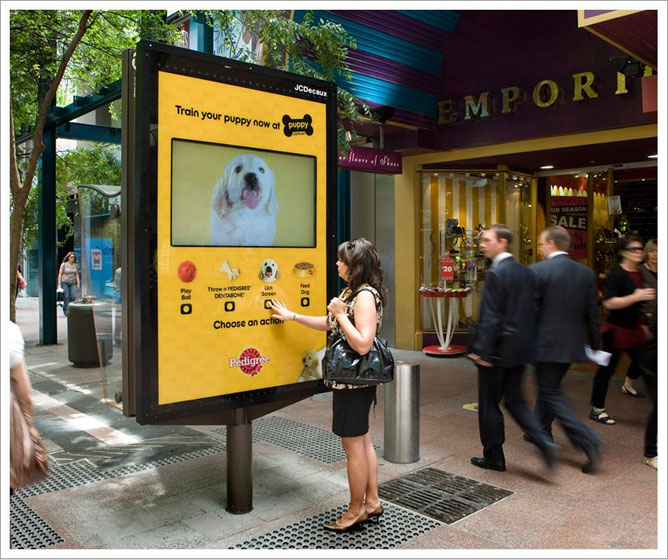
A good example is Pedigree's interactive signage, which let users play with and feed a dog on screen, capturing the joy of being a pet parent. Simple idea, memorable execution.

Interactive digital signage creating an immersive brand experience

Interactive and AR-driven screens turn passive viewers into active participants

DOOH Advertising Trend 4: Integration with Mobile Devices

Advertisers keep finding new ways to connect screens with smartphones. In 2026, digital signage displays and mobile phones work together more smoothly than ever. Technologies such as QR codes, NFC and beacons bridge the offline and online experience.

Someone can scan a QR code or tap their phone to get more information, unlock a special deal, or open exclusive content tied to the ad they just saw. In India this has become especially powerful because UPI and QR scanning are already second nature, so the step from seeing an ad to acting on it is genuinely one tap. It makes the experience more engaging for the viewer and gives advertisers a way to measure exactly how well a screen performed.

Digital signage integrated with mobile phones through QR codes

QR codes and NFC turn a glance at a screen into a measurable action on the viewer's phone

Digital OOH advertising linked to mobile for offers and content

Mobile integration links outdoor exposure directly to offers, sites and app installs

DOOH Advertising Trend 5: Data-Driven Insights and Analytics

One of the biggest advantages of digital OOH advertising is the ability to gather data and actually measure whether a campaign worked. In 2026, better analytics are central to optimizing DOOH campaigns rather than a nice extra.

Data analytics dashboard measuring digital OOH campaign performance

Real-time analytics show which screens, times and creatives are actually driving results

Real-time data on audience profile, engagement and campaign performance helps advertisers refine strategy while a campaign is still running. AI-powered analytics tools surface patterns in consumer behaviour and preferences, which lifts the return on DOOH spend. Footfall tracking and mobile-based measurement are also improving, which matters in India where the lack of a single agreed audience measurement standard has long held the category back. As measurement improves, more budget follows.

DOOH Advertising Trend 6: Sustainability and CSR Initiatives

As environmental concerns move to the centre of business planning, brands are paying closer attention to sustainability and corporate social responsibility. That is reshaping DOOH in 2026 and beyond. Advertisers are adopting eco-friendly practices such as energy-efficient screens, renewable power sources, and recycled materials in the structures that hold them.

There is a practical reason too, not just a reputational one. Modern LED displays draw significantly less power than older screens, and features like automatic brightness adjustment cut consumption further by dimming at night and brightening in daylight. Over a network of screens running every day, that shows up directly on the electricity bill. Brands are also using their screen time for public interest messaging, from safety campaigns to civic information, which builds goodwill alongside commercial content.

DOOH Advertising Trend 7: Rise of Creative Formats

In 2026, digital OOH is seeing a genuine boom in creative formats. Dynamic Creative Optimization enables real-time personalization that matches the mindset of the person passing by. Audio-based DOOH and anamorphic 3D videos are the formats getting the most attention, because they create an experience rather than an impression.

Marketers are adopting these approaches to make campaigns more memorable. With dynamic, 3D and audio elements, DOOH advertising can hold a viewer, lift brand recall, and stretch what is creatively possible outdoors. The bigger shift is that advertisers now build contextually relevant content specifically for the DOOH space, instead of resizing a print or TV creative and hoping it works.

Nike's AirMax 3D billboard in Japan remains a standout example of how far this can go. It combined advanced display technology, careful detail and real creative ambition to bring the shoe to life in a way that stopped people in the street.

Anamorphic 3D digital billboard creative format

Anamorphic 3D billboards create a sense of depth that makes people stop, film and share

The AirMax shoes appeared to step out of the billboard when viewers engaged. People could use their smartphones to unlock an augmented reality layer, try the shoes on virtually, customise colours and patterns, and see how they looked in their own surroundings. Physical and digital, in one moment.

How These Trends Fit Together

Read individually, these look like seven separate ideas. In practice they stack. Programmatic decides where and when your ad runs, dynamic content decides what it says, interactivity and mobile give the viewer something to do, and analytics tell you whether any of it worked. Creative format is how you make it memorable, and sustainability is how you run it responsibly.

TrendWhat it solvesBest starting point
Programmatic buyingRigid, expensive media buyingBuy by hour or audience, test small
Dynamic contentOne creative for everyoneWeather or daypart triggers
Interactive and ARPassive, forgettable adsTouch screens in high-dwell spots
Mobile integrationNo link between screen and actionA single clear QR offer
AnalyticsNo proof of performanceTrack scans and screen uptime
SustainabilityHigh power cost and poor opticsAuto-brightness and efficient LED
Creative formatsLow recallOne strong 3D or motion execution

Where Digital OOH Works Best in India

Location decides results. These are the environments delivering the strongest returns for digital OOH advertisers across Indian cities.

Metro and Transit Hubs

High footfall and genuine waiting time, which makes them ideal for QR offers, sequential storytelling and dayparted creative. Transit is among the fastest-growing DOOH formats in India.

Airports

Long dwell time and a premium audience. Best suited to immersive 3D, AR activations and brand-building campaigns aimed at travellers with time on their hands.

Shopping Malls

Shoppers already in a buying mindset. Works well for retail offers, interactive screens, wayfinding and mall-owned advertising inventory.

Roadside and Highways

Only a few seconds of attention, so this favours bold weather-triggered creative and anamorphic 3D that lands instantly.

Run Your DOOH Campaigns With Intelisa

Every trend on this page needs software that can schedule, trigger and update content across many screens in real time. That is exactly what Intelisa is built for.

  • Real-time communication so ads go live the moment you need them
  • AI-based personalization for contextually relevant content
  • Dynamic triggers by time, day, location and live data
  • Offline mode keeps screens running with limited connectivity
  • Manage one screen or a nationwide network from one dashboard
Explore the Platform
Digital OOH advertising network managed through Intelisa software

Stay Ahead of the Curve With Intelisa

In a channel that changes this quickly, staying on top of the trends is what separates a campaign people remember from one they walk past. Businesses across India, Canada, the USA and the Middle East are already putting these ideas to work. To execute them properly you need a reliable digital signage platform behind the screens.

With Intelisa, marketers get real-time communication so ads reach the right audience at the right moment, AI-based personalization for content that actually resonates, and an offline mode that keeps screens running even when connectivity drops. Whether you run a handful of displays or a national video wall network, it is all controlled from one place.

Want to Run Smarter DOOH Campaigns?

Tell us what you are planning and we will show you how Intelisa can power your screens, from a single billboard to a nationwide digital OOH network.

Book a Free Trial Today

Frequently Asked Questions

What is digital OOH advertising?

Digital OOH, or digital out-of-home advertising, is advertising shown on digital screens in public spaces such as billboards, malls, metro stations, airports and roadside displays. Unlike printed hoardings, the content is digital, so it can be updated instantly, rotated between several campaigns, and triggered by data such as weather or time of day.

What is the difference between OOH and DOOH?

OOH covers all out-of-home advertising, including printed billboards, posters and transit ads. DOOH is the digital part of it, where content plays on electronic screens. DOOH adds motion and video, instant updates, multiple messages on one site, data-driven targeting, and measurable performance, none of which static OOH can offer.

What is programmatic DOOH?

Programmatic DOOH is the automated buying and selling of digital out-of-home screen time in real time, similar to how online ads are bought. Advertisers can purchase by hour, location or audience condition instead of booking a site for weeks, which makes outdoor advertising far more flexible and accessible to smaller brands.

How big is the digital OOH market in India?

India's digital OOH advertising market was valued at around 2.4 billion US dollars in 2025 and is projected to grow at more than 11 percent a year over the coming decade. Growth is driven by metro and airport expansion, smart-city projects, more screens in retail and malls, and rising adoption of programmatic buying.

How do you measure the success of a DOOH campaign?

DOOH campaigns can be measured through QR scans and mobile actions, footfall tracking near screens, anonymous audience measurement, screen uptime and play logs, and the website visits or app installs the campaign drives. Combined with social sharing, this makes digital OOH far more measurable than traditional printed outdoor advertising.

Is digital OOH advertising affordable for small businesses?

Yes, increasingly so. Programmatic platforms allow brands to buy screen time by the hour or by audience rather than committing to long contracts, which lowers the entry cost. Small and medium businesses are among the fastest-growing group of DOOH advertisers in India, often starting with short, targeted campaigns in a single locality.

What software do I need to run digital OOH screens?

You need a digital signage platform that can schedule content, pull in live data feeds for dynamic creative, update many screens remotely, and report on uptime. Intelisa is a cloud-based, display-agnostic platform that handles all of this from one dashboard and keeps content playing offline if the internet drops.

The Bottom Line

Digital OOH advertising in 2026 is no longer about renting a big screen and hoping people look. It is about buying smartly, showing the right message at the right moment, giving people something to do, and proving what worked. The brands winning outdoors are the ones treating it as a data-driven channel rather than a decoration.

Want to know more about how Intelisa can help you execute impactful DOOH campaigns? Book a free trial with us today.

I
Intelisa Content Team

The Intelisa team writes about digital signage, DOOH and smart display technology for businesses across India. Questions? Write to us at info@intelisa.in

Categories
Digital Signages

Digital Signage Evaluation checklist

Digital signage is steadily and surely making its way into businesses across sectors. A real-time digital channel is much required, especially in a place where you have your attention.

Given their intention to ‘buy’, you have the time with your customers to pass on important pieces of communication. It is well known that customer engagement can dramatically uplift sales.

So why not use the golden time with your customer to communicate efficiently and increase engagement, and eventually sales?

Digital Signage Solutions, therefore, may be key, but requirements and needs across different sectors are not quite the same. Therefore, the solution deployed may differ. For example, a food outlet may not have a change in its menu or dishes as often as a clothing store, which has changing trends and designs.

With different requirements come different solutions, and more importantly, different price points and features.

To optimize your digital signage solution to the best possible configuration, one must keep in mind various parameters before deciding on a direction. For example, once hardware is procured, you are limited by its capabilities, so make sure you think it through and make a choice.

Here are some key points one must think through before making a decision on a digital signage technology for your business.

1) What Will It Be Used For?

Understanding the intended application of the digital signage solution is essential in evaluating the infrastructure you need.

Is it used to show basic offerings, or is it for secondary revenues like advertisements?
Would simple images and videos do, or would you at some point want to integrate with your ERP to show real-time data?

Let’s say you own a fast-food chain, and you want to use digital signage to showcase your menu offerings. In this case, the digital signage solution would be primarily used to display basic offerings such as burger combos, meal deals, and limited-time promotions.

However, if you plan to expand your business to include third-party advertisements, the solution should also support dynamic ad content, allowing you to generate additional revenue by showcasing ads from partner brands.

2) Hardware – Will It Satisfy Your Current Requirements as Well as in the Future?

Charting down current and future requirements for your solution is important, especially with respect to its hardware (device).
This is because your hardware may prove to be a constraint over time. Of course, don’t overthink this, there’s no need to imagine “maybe” scenarios to needlessly purchase an upgraded hardware when there is no foreseeable need.
For longer-term changes, there are innovative ways to work around upgrading.

For example, A signage whose purpose is to share best practices in a corporation may be required at some point to enable live streaming of leadership messages. Hence, this must be accounted for in the hardware. However, there is no need for complex advertising features for this use case.

3) Ease of Use

In our experience, this cannot be emphasized enough. Complex installations, deployments, and needless integrations make a solution difficult to adopt by your own staff, who are to be its users. To start with, focus on the “ease of use” of the product. It should be plug-and-play and easy to understand for users. And in consecutive steps, advanced features can be plugged in.

Consider a retail store where the staff is responsible for managing the digital signage. The solution you choose should have a user-friendly interface that requires minimal training. A plug-and-play system with an intuitive content management platform would enable your staff to easily update and schedule promotions, ensuring smooth operation without the need for extensive technical expertise.

4) Dashboards and Alerts to Monitor

One of the facets of monitoring remotely is to have aggregated data or dashboards that can be centrally viewed by users. For example, if the utilization of the screen or revenue earned for a Digital OOH provider is a key metric, a real-time dashboard of utilization and revenue earned, and its trends will be key to the management.

Such Key Performance Indicators (KPI’s) should be distilled out and easily viewable.

In addition, you may trigger alerts on certain events. For example, in the previous example, if the utilization is too low, one may send out an email or an SMS to the management mentioning that the revenue earned is currently below the minimum threshold.

5) Capability to Integrate – Social Media / ERP

One should always check out the ability of a solution provider to integrate with ERPs and social media. Many times, solution providers use out-of-the-box solutions and don’t have access to customize beyond a certain level, which may restrict the solution’s capability.

Imagine you operate a fashion boutique and want to create engaging campaigns by incorporating user-generated content. With social media integration, customers can be encouraged to post pictures of themselves wearing your brand with a specific hashtag. These posts can then be aggregated and displayed on the digital signage within your store, showcasing real customers and promoting a sense of community and authenticity.

6) Ability to Add Sensors

These are also very important and exciting additions to the core product. The ability to add sensors tremendously increases digital signage use cases. For example, with motion sensors, one can play videos based on which product is viewed or picked up by customers, substantially increasing engagement and sales.

Imagine you’re the administrator of a busy hospital. Incorporating sensors into your digital signage can improve the overall patient experience and streamline hospital operations.

For instance, you can install occupancy sensors in waiting areas to monitor the number of people present. When the occupancy reaches a certain threshold, the digital signage can display messages encouraging patients to move to quieter areas, reducing overcrowding and improving comfort.

7) Pricing

After the technical requirements are satisfied, the next key parameter is, of course, cost and how it can be optimized. One should have a pricing model that works on features used and/or volumes. One can then ‘scale it up’ later to add in more features and optimize costs.

8) Lead Time, Refresher Trainings & Scalability

These three may seem minor, but important points to keep in mind, and can be the last step in your conversations with service providers. You should align on a lead time for the end-to-end installation of the digital signage solution.

In addition, frequency and duration of remote trainings can be enquired about. Many a metimethe operator using the solution change, and so a refresher training for them, as well as for any other personnel, must also be enabled.

Finally, scalability and ease of expanding the solution to different locations, and the mobility of existing installations, must also be gauged. This is generally easy, and then it should not be an issue.

At Intelisa, we are happy to consult you on the optimum configuration you would need for your requirements, so that you don’t need to worry about the tech, and can focus on what you do really well, which is customer engagement and business growth!

Categories
Digital Signages

5 Coolest Digital Signage applications from across the world

by Alok Dukle

Alok Dukle is Co-Founder & CEO of Intelisa with over 10 years of experience in early stage growth ventures, venture investments and Internet of Things (IoT). He has previously worked with the USD 21Bn Mahindra Group, in its Private Equity and Incubation division.

Display communication is one of the oldest forms of communication. In fact, cave paintings, which date back a whopping 40,000 years to the Stone Age (that’s right!), were the first form of display communication.

The resilience of the mighty display communication is given the fact that it is in physical space, which we can presume will be here to stay, perennially.

With the onset of digital display technologies such as LCDs, LEDs, the IoT technology, and more, Digital Signage Solutions has evolved greatly. What was a one-way static medium can now be an engagement-driven two-way digital medium, which opens up a world of possibilities.

Here are some incredibly cool applications that we spotted globally powered by this intelligent technology:

1) Virtual Trials: Redefining the Shopping Experience

Virtual trials have revolutionized the way people shop for clothes, offering a unique and immersive experience through the use of gesture control and virtual reality technologies. Imagine stepping in front of a digital mirror that not only reflects your image but also transforms into a dynamic screen, allowing you to virtually try on different outfits without the need for physical garments.

One remarkable example of this cutting-edge technology can be found in a store located in Dubai. By leveraging embedded sensors and advanced software, customers can now indulge in the extraordinary feature of trying on clothes virtually. Through intuitive gestures, users can swap between various clothing options and instantly see how they look, thanks to incredibly realistic 3D renders.

Furthermore, this innovative approach to shopping enables retailers to break free from the limitations of stocking clothes in-store. Once a customer finds their perfect fit, the purchased clothes can be conveniently shipped directly to their location. This seamless integration of Interactive Kiosk technology with omnichannel sales creates a dynamic and efficient shopping ecosystem.

2) Community Building in Cities: Strengthening Connections

Community building plays a vital role in fostering connections and enhancing the sense of belonging within cities. In bustling metropolises like New York, digital signages lining bus stops have become a powerful tool for staying in touch and building a vibrant community.

These digital displays serve multiple purposes, including communicating the latest local events and sharing vital information from the local government with commuters. Additionally, the inclusion of advertisements generates revenue while ensuring the displays remain financially sustainable.

One notable feature of these digital signage is their ability to facilitate real-time engagement campaigns and contests, such as the captivating ‘Halloween photo campaign’ held in New York. By actively involving commuters in these initiatives, these displays keep individuals engaged and create a shared experience within the community.

Similarly, in Boston, solar-powered screens utilizing e-ink technology are making a significant impact. These screens effectively address one of the critical challenges associated with display technology—ensuring a continuous power supply.

Interactive Kiosk technology

3) Real-time Engagement-Driven Hoardings: Amplifying Brand Communication

Real-time engagement driven hoardings have emerged as a powerful tool for brands to achieve greater impact and maximize their return on investment.

One remarkable example of this is a Digital Billboard that captured the internet’s attention and went viral. By incorporating real-time engagement features, brands can actively involve the audience and create an immersive experience. This interactive approach sparks curiosity, encourages participation, and generates a sense of connection with the brand.

Digital Billboard India

Image Source: https://twitter.com/relientkenny/status/1206654881391685640

4) Dynamic Design Experience: Enhancing Aesthetics with Digital Signages

Digital signages serve as a powerful tool for creating a dynamic design layer that enhances the overall aesthetics and architectural integration of spaces. One compelling application is the use of digital signages in lobbies, where they seamlessly blend in with the surroundings while offering a visually captivating and informative experience.

Imagine a lobby video wall featuring an array of meticulously crafted screens. Not only does this setup present a premium and aesthetically pleasing design, but it also serves as a versatile platform for showcasing key information when needed.

Whether displaying welcome messages, event schedules, or engaging multimedia content, the dynamic nature of the digital signage adds a layer of sophistication and modernity to the space.

Digital Billboard in India

5) Immersive 3-D Experience

3D digital billboards are a cutting-edge form of advertising that utilizes advanced technology to create captivating and immersive experiences. These billboards blend the virtual and physical worlds, capturing viewers’ attention and leaving a lasting impression.

digital billboard advertising software

Image Source: Instagram

One remarkable example of a 3D digital billboard is Nike’s AirMax campaign. Using augmented reality, the billboard brings the AirMax shoes to life, allowing users to virtually try them on, customize colors and patterns, and see how they look in different real-world environments. This extraordinary fusion of technology, detail, and creativity showcases Nike’s commitment to innovation in advertising.

6) Light 'em Up and Gain Eyeballs: Times Square's Exemplary Impact

When discussing applications for digital signage, it would be remiss not to mention the iconic Times Square in the heart of bustling New York City. This vibrant city square stands as a testament to the immense impact and engagement that digital signage can achieve.

Times Square is filled with a lot of digital signage adorning buildings and captivating the attention of millions of passersby. These dynamic displays, with their vibrant colors, captivating animations, and larger-than-life visuals, are the lifeline of the square. They create an electric atmosphere and contribute to the unique identity of Times Square.

If we were to replace these digital signage with static billboards, Times Square would lose its dynamic and immersive character.

Digital Billboard India

Will be happy to receive additional examples, comments & ideas on your take on innovative digital signages that add to communication and engagement. Do write to us at info@13.201.127.92

Categories
Digital Signages

Digital Screen Signage vs. Static Communication: Which is Better?

Digital Screen Signages essentially convert static communication to digital display communication. Static communication is a one-time use-and-throw type of communication – think of the countless posters of fashion brands showing the latest designs, or even the pinned-up notice boards in schools or offices, or the paper food menus at restaurants, as well as the flex standees in events or hoardings on public streets.

Every avenue one sees around us uses some form of communication; think about it.

Why is that? Well, that’s an easy one simply because communication with stakeholders, be it customers, employees, partners, and so on, will always be integral to conveying and generating awareness.

The problem, however, is with static communication, which has many disadvantages. Let’s examine a few of these disadvantages:

Disadvantages of static communication

Uneconomical & Non-Eco-Friendly

One of the major downsides of static communication is its lack of reusability. Paper and flex posters, once utilized, need to be discarded, resulting in significant waste production. For instance, in India alone, approximately 15,000 tonnes of flex material are used monthly, highlighting the non-eco-friendly nature of one-time-use communication. Digital signage solutions, on the other hand, allow for reusable communication that reduces waste and promotes sustainability. For example, a digital screen at a retail store can display different promotional messages throughout the year, eliminating the need for frequent printing and disposal of paper posters.

High End-to-End Costs

Printing costs, transportation expenses, and manual labor contribute to the overall expense of deploying traditional static communication methods. These costs can quickly accumulate, especially when communicating across multiple locations. By adopting digital signage, businesses can significantly reduce costs associated with printing, transportation, and manual labor. For instance, a chain of restaurants can centrally manage and update their digital menu boards using restaurant digital signage, eliminating the need to print and distribute physical menus.

Manual and Inconvenient

Coordinating the placement of static communication materials across different venues can be a cumbersome and time-consuming process. This manual effort often leads to logistical challenges and inconvenience.

Digital signage software simplifies the process by allowing centralized control and instant updates. For example, an event organizer can easily change and display event schedules and announcements on digital screens across venues, eliminating the need for manual updates.

Advantages of Digital Screen Signages:

Fortunately, digital screens integrated with advanced digital signage solutions provide an efficient and flexible alternative to static communication. Here are some key advantages of leveraging digital signage:

Reusability

Digital screen signages offer the advantage of long-term reuse as a communication medium. With digital creatives, messages can be easily changed and updated, making the screens more versatile and environmentally sustainable.
For example, a transportation company can use digital signboards at bus stops to display dynamic route information and updates, eliminating the need for frequent manual updates of fixed schedules.

Dynamic Content and Instant Updates

With a simple press of a button, digital display boards enable instant updates to displayed content. This allows for real-time communication changes, ideal for time-sensitive promotions.
For instance, a retail store can quickly update digital screens to showcase new product launches, ongoing sales, or limited-time offers, capturing customers’ attention and driving immediate action.

Modern retail space with digital displays

Centralized Control

Cloud-based digital signage systems can be centrally controlled, facilitating seamless communication management across multiple locations. This ensures consistent branding and messaging, streamlining operations for businesses and organizations.
For example, a multinational corporation can use a centralized signage platform to share company-wide announcements, ensuring uniform communication across all offices.

Enhanced Visibility

Research suggests that digital signage displays offer up to twice the visibility compared to static posters. High brightness levels and dynamic content—like videos—captivate viewers and improve message retention.
For example, a museum can use interactive digital signage to showcase exhibits with visuals and videos, offering visitors a more immersive experience.

Interactive Features

Digital signages provide opportunities for incorporating advanced interactive features. From social media integration to impression management, these interactive elements engage the audience and enhance the overall communication experience.
For instance, a shopping mall can integrate digital signage with social media to encourage shoppers to engage with the brand online, building community and user-generated content.

digital display

Expanding Applications of Digital Signages

The benefits of digital signage technology extend across industries, use cases, and spaces:

  • Retail: Digital signages can be used in retail environments to showcase product information, promotions, and customer reviews, enhancing the shopping experience and driving sales.
  • Hospitality: Hotels and resorts can utilize digital signages for displaying event schedules, wayfinding, and personalized guest messages, improving guest engagement and satisfaction.
  • Healthcare: Digital signage in healthcare facilities can provide important information such as appointment reminders, health tips, and emergency notifications, enhancing patient communication and overall experience.
  • Transportation: Airports, bus stations, and train terminals can employ digital signage for real-time updates on arrivals, departures, and travel information, improving passenger communication and reducing confusion.
  • Education: Educational institutions can leverage digital signage for announcements, campus maps, event promotions, and showcasing student achievements, enhancing campus communication and engagement.

Transforming Communication with Intelisa: Unlocking the Power of Digital Screen Signages

Intelisa digital signage solutions empower organizations to make communication more impactful, dynamic, and sustainable. With Intelisa digital signage software, businesses can streamline operations, enhance brand consistency, and engage their audiences like never before.

From retail outlets and corporate environments to healthcare clinics and public spaces, Intelisa enables businesses to deliver messages that truly resonate with their audience. With Intelisa’s centralized dashboard, users can easily manage and update content across multiple screens and locations, ensuring consistent, high-quality messaging.

So, don’t wait any longer, get your free Intelisa digital signage trial today and experience the future of digital communication.

Categories
Digital Signages

Healthcare Digital Signage Software for Hospitals & Clinics

Effective communication lies at the heart of delivering exceptional patient care in the ever-evolving healthcare landscape. From bustling hospital corridors to serene clinic waiting rooms, transparent and timely information is crucial to improving the patient experience.

With rapid technological advancements, healthcare facilities are adopting advanced solutions to transform how they communicate with their patients entirely. One such innovation adopted by the healthcare industry is digital signage software for hospitals.

Gone are the days of outdated notice boards and static signs; now, dynamic healthcare digital signage infused with technology is breathing new life into patient communication. But if you are unaware of how to use digital signage solutions in healthcare settings, we are here to help you.

This article will dive deep into the right ways to maximize your patient experience using digital signage for healthcare. So, let’s get started!

Setting clear objectives

Start by determining the specific goals you want to achieve with digital signage. Here are some common objectives of setting up signage in hospital settings:

Provide information to patients, visitors, and staff.

Use digital signage displays to provide important information like waiting times, visiting hours, emergency alerts, and general hospital announcements. It helps to keep people informed and reduce confusion.

Assist in wayfinding.

Hospitals can utilize digital signage to assist patients and visitors in navigating complex buildings. Interactive maps and directions can be displayed to guide individuals to specific departments, making it easier for them to find their way around the facility.

Digital Signage Software for Hospitals

Educate patients.

Digital signage can educate patients about various health topics, medical procedures, and healthy lifestyle choices. It can display informative videos, slideshows, or animations to promote health awareness and informed decision-making.

Enhanced staff communication.

Digital signage can be a valuable tool for internal communication within the hospital. It can display essential announcements, employee recognition, training schedules, and other relevant information for staff members.

Promote services and events.

Hospitals can use digital signage to communicate or generate awareness about their services, health campaigns, and upcoming events. It can help raise awareness among patients and the local community about available medical expertise, screenings, workshops, or support groups.

Choosing the right digital signage software

Now that you have assessed your goals and objectives, it’s time to select a digital signage software that aligns with them. Here are some steps you can follow to make an informed decision:

Evaluate specific requirements of your healthcare setting

Consider factors such as the size and layout of your facility, the number of screens you need, content management capabilities, integration with existing systems (EMR, scheduling, etc.), and any compliance regulations (HIPAA, ADA) you must adhere to.

Research available options

Conduct thorough research to identify digital signage software providers specializing in the healthcare industry. Look for companies experienced in healthcare that understand the sector’s unique needs. Explore websites, read customer reviews, and compare features, functionality, and pricing.

For instance, healthcare providers love how Intelisa’s cloud-based digital signage solution helps them push educational content for patients to multiple locations from a single dashboard. With digital signage software live in over 2000 locations, digital communication becomes more effortless.

Prioritize content management capabilities

A robust content management system (CMS) is essential for creating, scheduling, and managing content on your screens. Ensure that the digital signage software supports easy content creation, editing, and scheduling by time, location, or audience, and supports multiple media formats (images, videos, live feeds).

Look for seamless integration

The software must seamlessly integrate with your existing electronic medical records (EMR) system, scheduling software, data feeds, or third-party applications. Integration can streamline workflows and enable dynamic content delivery based on real-time data.

Security and compliance

Healthcare environments handle sensitive patient information, so security and compliance are crucial. Ensure that the digital signage software adheres to industry-standard security protocols and can protect data privacy.

Once you have shortlisted a few digital signage software options, request demos or trials from the vendors. This will allow you to test the software firsthand and evaluate its ease of use, interface, performance, and overall user experience. Pay attention to how well it aligns with your specific requirements and objectives.

Plan your content strategy.

Understanding your audience is crucial to plan your content strategy effectively. Consider the demographics and characteristics of the people viewing the digital signage. Patients, visitors, and staff may have different information needs and preferences. Conduct surveys to gather insights on what content they find valuable and engaging.

dynamic healthcare digital signage

Remember that creating a content calendar is an integral part of your strategy. Develop a schedule for content updates, taking into account the frequency and timing that works best for your audience. Plan for daily, weekly, and monthly content rotations, and consider any special events or campaigns you want to promote.

Bonus tip: Engage with various stakeholders, including hospital departments, doctors, nurses, marketing teams, and patient representatives, to gather relevant content and ensure accuracy.

Determine display locations

When determining the best locations for digital signage displays, it’s crucial to consider strategic placements that can effectively reach a large audience. One of the key areas to focus on is the waiting rooms. These spaces are often filled with patients and visitors looking for information or entertainment while waiting.

digital signage software for hospitals

Reception areas are another prime location for digital signage displays. The reception area is usually the first point of contact for patients and visitors entering a facility. Highlight important announcements, showcase services or products, or display welcome messages.

Lastly, focus on hallways and patient rooms, as they are often high-traffic areas within a facility, making them an ideal spot for digital signage displays.  This can be particularly effective for sharing important information, such as directions, upcoming events, or health and safety reminders.

Note: Consider the height and orientation of the displays to ensure optimal visibility and readability as people walk by.

Create and manage content.

Use the digital signage software to design and schedule your content. Consider creating different content playlists for different times of the day or specific areas within the healthcare facility. Update content regularly to keep it fresh and relevant.

For instance, during the morning hours, when the facility is typically busy with patients, display content related to healthy living, preventive care, and reminders for regular check-ups. In the afternoon, when the waiting rooms are less crowded,  showcase information about upcoming health education seminars, wellness programs, and testimonials from satisfied patients.

healthcare digital signage

And the best part? Digital signage solutions like Intelisa have a scheduling feature that automatically switches between playlists based on the time of the day. This ensures that the displayed content remains relevant and captures the target audience’s attention at specific times.

Tailor content to different audiences

Segment your content to cater to different patient demographics and healthcare needs. For example, you might display information about preventive care for older adults in geriatric wards or promote pediatric health initiatives in children’s areas.

Conclusion

In conclusion, digital signage software for healthcare has emerged as a powerful communication tool for hospitals and clinics. By incorporating dynamic and cloud-based digital signage displays, healthcare facilities can deliver vital information effectively, improve patient satisfaction, and enhance operational efficiency.

However, investing in a user-friendly digital signage solution is key to long-term success. For instance, Intelisa offers advanced features like live streaming, social media integration, and centralized control empowering hospitals to reuse marketing content across channels effortlessly.

To learn more about how to fully utilize digital signage in your hospital or clinic setup, book a free trial with Intelisa today and experience smarter patient communication firsthand.

Categories
Digital Signages

How to maximize ROI with a dynamic digital signage?

Are you tired of spending money on traditional advertising methods with little to no return on investment? A dynamic digital signage is here to ensure you spend your bucks right!

This modern advertising approach can help you grab the attention of your target audience and maximize your ROI. With vibrant visuals, eye-catching animations, and compelling content, dynamic digital signage is the perfect way to get your message across in a fun and engaging way.

But what is digital signage, and how effective are digital displays in improving ROI? We will talk all about it in this article to ensure you know what smart digital signage can be utilized for! So, let’s get started.

Digital signage meaning

Digital signage refers to the use of digital displays, such as monitors or TVs, to showcase information, advertisements, or promotions. Digital signage and displays can be static or interactive and are commonly seen in public spaces, stores, or restaurants

style=”text-align: justify;”>Digital signage as a service is a cloud-based solution that enables businesses to remotely manage and update their digital signage content. This technology is an effective way for businesses to engage and inform customers and can be used in various settings such as retail, hospitality, and healthcare.

6 Steps to maximize ROI with dynamic digital signage

Now that we know what digital signage is, let’s get ahead with the steps to maximum ROI with dynamic displays.

1. Set clear goals and objectives of installing dynamic digital signage

Dynamic displays are used to achieve many different goals and objectives. In retail, the main goal is often to drive sales and enhance the customer experience.

According to Forbes, “retailers aim to use dynamic signage as a way of personalizing the shopping experience, showing customers how products can be used and enticing them with special promotions or offers.”

Dynamic Digital Signage

Similarly, in healthcare, the goals for dynamic signage include improving communication with patients, reducing wait times, and enhancing patient satisfaction.

Lastly, for restaurants, digital signage can be used to improve menu visibility, showcase specials, and increase upselling.

According to QSR magazine, “digital menu boards have become a necessity for restaurants to stay competitive by easily adapting to price changes, menu updates and new product rollouts.”

In a nutshell, dynamic digital signage is a versatile tool that can serve various goals for businesses. So, get started and identify the goals and objectives of setting up a digital display!

2. Identify your target segments and display engaging content

Identifying your target audience is crucial to maximizing ROI from installing digital signage. You can easily tailor the content of your digital signage by understanding the specific needs, behaviours, and preferences of your target audience.

digital signage for retail stores

For example, retail stores can identify different customer segments based on demographics, age, and shopping preferences. A quick analysis of customer data and insights goes a long way in improving the overall engagement.

3. Select the right hardware and software.

It’s crucial to select the right hardware and software as it directly impacts the performance, reliability, and effectiveness of the digital signage solution.

Some factors to consider include display screen size and resolution, media player and content management system, connectivity, and security features. For instance,  Intelisa is a fully secured digital signage solution that ensures no downtime and works in offline mode as well.

The hardware components, such as displays and media players, should be selected based on the specific requirements of the digital signage deployment.

hardware and digital signage software

For example, if the digital signage displays are intended for outdoor use, they should be weatherproof and have high brightness levels for clear visibility in sunlight. Similarly, media players should have sufficient processing power and memory to smoothly run the content and software.

Furthermore, choosing high-quality hardware from reputable brands ensures that the digital signage solution operates for an extended period without frequent breakdowns, reducing the total cost of ownership (TCO) and maximizing ROI.

4. Select a digital signage solution with integration features.

Make sure you test the integration and compatibility of digital signage solutions before making a choice. Digital signage solutions often require integration with other systems, such as content management systems (CMS), ERP’s, Point of Sale (POS) systems, data sources, third-party applications, or hardware peripherals (e.g., sensors, touchscreens, etc.).

cloud-based digital signage solutions

Selecting hardware and software that are compatible with existing systems or have built-in integration capabilities ensures seamless operation and functionality, maximizing the value and effectiveness of the digital signage solution.

5. Create compelling content that resonates with the audience.

The success of dynamic digital signage depends on the content you display. Are you creating content compelling enough to lure in your target audience? If not, here are some tips you can use:

    • Use eye-catching graphics
      High-quality graphics with visually appealing images, videos, or animations can immediately grab attention and create an impact. For example, in a retail store, using vibrant videos with dynamic animations can showcase the latest products or promotions and entice customers to make a purchase.
    • Encourage customers with interactive content.
      Interactive content encourages audience engagement and improves the overall effectiveness of digital signage displays.
      For example, restaurants can use interactive menus to enhance the overall dining experience and boost sales.
    • Display real-time information
      Displaying real-time information such as news updates or social media feeds can create a sense of urgency and relevance. For example, in a healthcare facility, displaying real-time wait times or patient testimonials can improve the overall patient experience.
    • Incorporating user-generated content
      User-generated content, such as social media posts, customer reviews, or testimonials, can add authenticity and social proof to the digital signage.
      For example, retail stores can display positive customer reviews to boost brand credibility and encourage customers to make a purchase.
    • Using storytelling to your advantage.
      Storytelling content with compelling narratives or emotional appeal can resonate with the audience and create a memorable experience.
      For example, stores can display their origin story or brand mission and vision through a compelling story to build a connection.

6. Test and optimize digital signage displays.

Testing and optimizing dynamic displays play an important role in garnering maximum engagement and revenue. Start by creating multiple versions and layouts of your content and test them against each other to see which one performs better (A/B testing). Experiment with different CTAs, colors, fonts, content types, etc.

Conduct a deep content performance analysis using analytical data and insights. This can involve tracking metrics such as impressions, click-through rates, or conversion rates. Use this data to optimize your content strategy and create more effective and engaging content.

Conclusion

If you’re looking for a comprehensive digital signage solution that can help you maximize ROI, look no further than Intelisa. With our cutting-edge cloud-based digital signage software, you can create dynamic and engaging content that captures attention and helps you achieve your business goals.

Our digital signage for restaurants, retail stores, and healthcare centers offers unmatched flexibility, security, and scalability. Plus, our user-friendly interface and expert support make it easy to get started.

So, don’t wait any longer, take your brand visibility to the next level with Intelisa’s dynamic digital signage solutions and book a free trial today!

Frequently Asked Questions (FAQs)

Dynamic digital signage is a modern approach to advertising that uses digital displays to showcase content such as videos, images, and text.

Any business that wants to increase brand awareness, promote products or services, and improve customer experience can benefit from dynamic digital signage. Examples include retail stores, healthcare facilities, restaurants, and more.

The content you display on your digital signage should be visually appealing, informative, and relevant to your target audience. Examples include promotions, product demos, social media feeds, and news updates.

When selecting hardware and software for your digital signage, consider factors such as display size and resolution, compatibility with your content management system, and ease of use for your staff.

Maximizing ROI with dynamic digital signage requires measuring success. Track customer engagement, sales data, and foot traffic. Use surveys or feedback forms to gather insights and A/B testing to compare content and messaging effectiveness.

Categories
Digital Signages

5 ways of using digital signage in restaurants

We all have heard of the saying, “you eat with your eyes first,” and what better way to tease your customers’ taste buds than with visually appealing digital displays?

Digital signages provide an excellent opportunity to showcase your restaurant’s menu items and create an engaging visual experience for your customers. Using digital menu boards, you can feature your menu items and exciting deals in a visually appealing and informative manner.

So, whether you are a small restaurant owner or a large chain, read on to discover how digital signage can enhance your customers’ dining experience and help grow your business

Showcase menu items.

Digital signage can display high-quality images of your restaurant’s menu items, making them more visually appealing and tempting to customers.

Points to Consider While Setting Up Digital Menu Displays

Here are some points you must consider while setting up your digital menu displays:

  • Hire a professional photographer to take compelling pictures of your menu items. Remember that high-quality images play a significant role in capturing attention.

  • Display nutritional facts to show how your meals contribute to a healthier dining experience.

  • Give item descriptions to help customers better understand what they are ordering.

  • Highlight your bestselling items to entice customers into trying them.

  • Create short yet compelling videos of your menu items being prepared and served.

Digital Signage in Restaurants

Bonus tip: Create interactive kiosks or interactive menus on the digital signage system where customers can browse and customize their orders. This can enhance the ordering experience and make it more personalized.

Promote special discounts and offers.

Promoting special discounts and offers using digital signage is an effective way to attract customers and increase sales. Here are some key areas you must focus on while highlighting these offers:

  • Make the offer stand out using bold fonts, contrasting colors, and appropriate placement.

  • Use engaging visuals like photos and videos of menu items on offer to make it more appealing.

  • Include a strong CTA like limited time only or order now and save to initiate immediate action.

  • Use a countdown timer to create a sense of urgency and encourage customers to take action before the offer expires.

  • Keep updating your offers on digital displays and clarify how much money customers can save by taking advantage of the special offer.

digital billboards

Such offers work exceptionally well at capturing attention and increasing orders.

Display customer reviews on your restaurant's digital signage.

Displaying customer reviews on digital signage is a great way to showcase your restaurant’s positive reputation. It helps build customer loyalty and recommendations. But to ensure you do it right, here are some tips you can use:

  • Choose the most positive reviews to be displayed on the signage.

  • A simple “good food” won’t cut it if you already have, “I recently visited XYZ restaurant and was blown away by the overall experience… I can’t wait to go back!”

  • Here are some more examples of reviews that cut.

display technologies

And if you have many such positive reviews, please show them off!

  • Use eye-catching visuals to make the reviews easier to read. Feel free to use various images and graphics to improve the overall look.

  • Extract reviews from platforms like Google and Yelp to showcase your reputation online.

  • Use a scrolling display to show multiple positive user reviews and highlight different areas simultaneously. This will create an engaging display for customers who will likely pay attention.

  • Encourage customers to leave reviews with various incentives.

  • Update digital signage reviews frequently to keep the display fresh and engaging for customers.

Provide sources of customer entertainment.

Digital signage can be a powerful tool for providing entertainment in a restaurant. Let’s look at some ways you can use to keep customers content:

  • Display live sports events to attract sports fans and create a lively atmosphere. They will likely sit and enjoy the game until the end while trying different items on your menu. A win-win for both, isn’t it?

  • Restaurants with a lively social media presence can use digital signage to showcase their social media feeds. You can include captivating Instagram photos, reels, and user-generated content to capture attention.

  • Use a digital signage display to show mainstream TV shows. People sometimes visit restaurants to pass the time, and there’s no better entertainment than a cup of coffee, some snacks, and their favorite TV show on a screen.

  • Run contests through digital signage and provide special discounts to winners or even free meals.

  • Work on creating custom animation videos of your restaurant menu items or specials to garner attention.

Digital signage technology

Bonus tip: When using digital signage displays for customer entertainment, ensuring the content is high-quality and relevant to your brand is essential. Avoid overwhelming customers with too much information or distracting content. Keep the displays simple, visually appealing, and easy to understand.

Give a sneak peek at your brand story.

Every great business stems from a creative idea followed by proper execution. How about sharing that creative idea with your customers? Let’s take an example to understand this better:

“Chew-Chew’s is a restaurant started by a group of food-loving locomotive engineers who had a knack for whipping delicious meals in their train’s dining car. They decided to take their culinary skills off the rails and open a restaurant that combined their two passions: food and trains.

The result was a quirky and fun establishment that served hearty meals inspired by classic railroad car fare. From the “Boxcar Burger” to the “Train Wreck Tacos,” Chew-Chew’s has something for everyone. The décor is full of train-themed knick-knacks, and the waitstaff wears conductor hats. It’s a truly unique dining experience that’ll leave you chugging back for more!”

Now that’s an interesting story that deserves attention. Remember that people are always curious to learn about unique restaurant themes. Go ahead and give them the information they need, some creative display technologiesand visuals.

Install your digital signage display today!

In conclusion, digital signage can be a powerful tool for restaurant businesses to enhance their customer experience and increase revenue. By using digital signage creatively, such as displaying menu items, promoting specials, showcasing social media, entertaining guests, and streamlining ordering and payment processes, restaurants can engage customers in new and exciting ways.

Digital Signage Platform Suggestion – Intelisa

One solution that can help restaurants implement digital signage is Intelisa. Intelisa is a digital signage platform that allows businesses to create and manage content on multiple screens from a single location. With features such as menu scheduling, menu template designs, social media integration, and customer analytics, Intelisa can help restaurants maximize the potential of their digital signage.

Get started and book a free trial today!

Need a quote or product info?
Our sales assistant is here to help.